
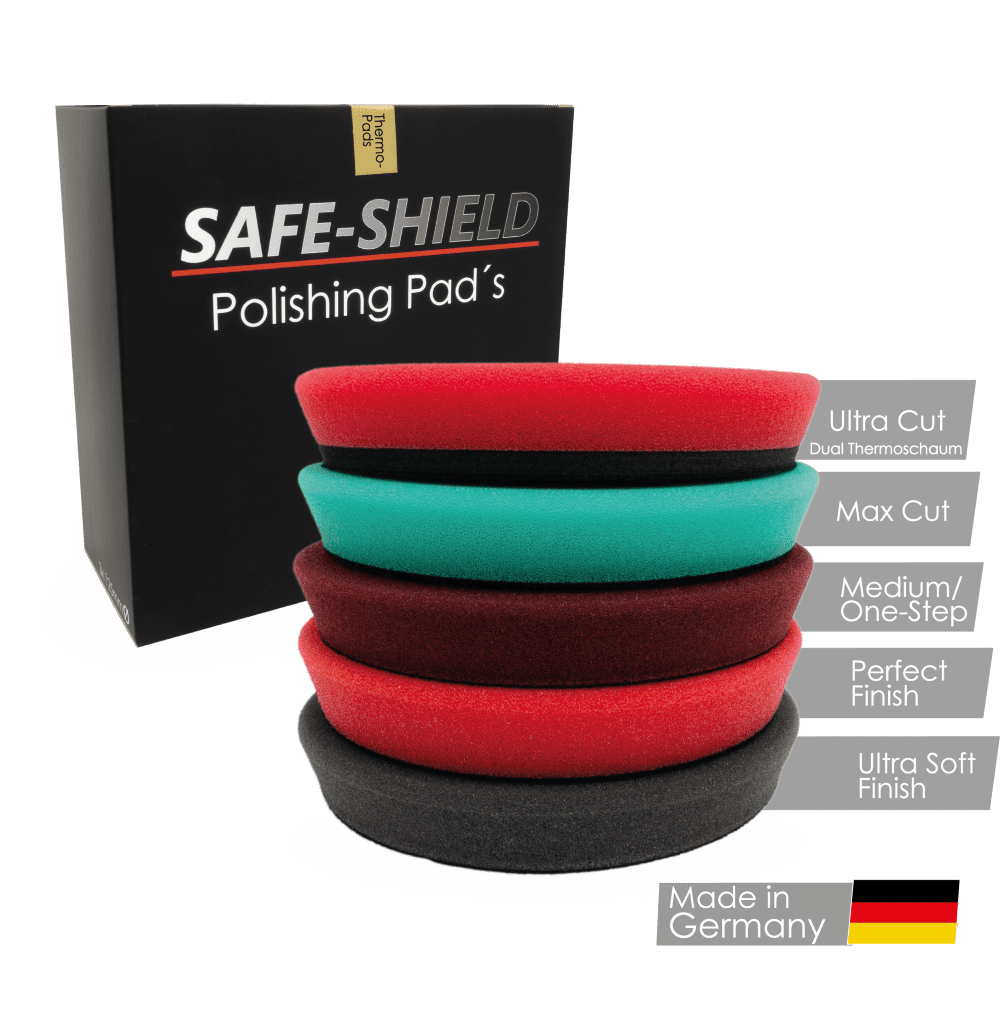
The polishing pad you need does not depend solely on its colour or hardness. What matters is the combination of paint condition, polish, pad, machine and desired result. In this guide you’ll learn when a hard or soft foam pad makes sense, when microfibre or wool delivers more cut, and how to choose a suitable combination for cut, one-step and finish.
If you want a direct comparison, you can find all Safe-Shield polishing pads from cut to finish here. For a safe choice, you should still first create a test spot with the mildest combination that is likely to be effective.
What are thermo polishing pads?
Thermo polishing pads are pads made from foam engineered for thermal stability. Their key advantage is not that no heat is generated while polishing. Friction still generates heat. The foam is designed to maintain its specified compression hardness and thus its working behavior as consistently as possible under thermal load.
If a conventional foam becomes significantly softer during use, cut, machine control and finish can become more inconsistent. In contrast, a shape- and pressure-stable thermo-foam allows more reproducible pad performance. Its open-cell or reticulated structure also supports air and residue transport. However, this does not replace controlled working practices or regular cleaning and changing of pads.
Which polishing pad is suitable for what?
Actual cutting performance always results from the interaction of polish, pad, machine, paint hardness and technique. A hard pad transfers movement more directly and can increase the cut of a compound. A soft pad conforms more to the surface and is mainly used for fine finishing work.
Always start with a test spot. Use the mildest combination that you still expect to correct the existing paint defect. Only if the result is not sufficient do you move in a controlled way to a stronger combination.
Cut: correcting heavier defects
Our Max Cut polishing pad with Max Cut compound is designed for stronger, controlled removal. Choose this level if a milder combination is not sufficient and the paint condition allows correction. A subsequent finishing step may be necessary.
One-step: combine correction and gloss
The Medium One-Step polishing pad with our Black-One polish is a starting point for light to moderate defects. If the test spot achieves a clear finish, a single polishing step may be enough.
Finish: refining fine polishing marks
Our Perfect Finish Pad with the Perfect Finish Polish is designed for holograms and fine marks. This combination is also suitable for refining after heavier correction work.
Very gentle finish: assess sensitive paint
On particularly sensitive paint you can test the Ultra Soft Pad with Perfect Finish. Paint colour alone does not indicate whether the paint is soft or hard. The decisive factor remains a controlled test spot.
How to adapt the combination to the paint
If Max Cut is not sufficient in the test spot on very hard paint or GRP, the Ultra Cut polishing pad can be tested as a stronger foam pad option. If a cutting step leaves fine polishing marks, follow up with a finishing step. On particularly soft or sensitive paints, the Ultra Soft Pad can deliver a cleaner result than a harder finishing pad. You can find suitable products in our overview of Safe-Shield polishes from cut to finish. To compare on your own paint, use the polishing system test kit.
Foam, microfiber or wool: What’s the difference?
Foam pads: controllable and versatile
Foam pads cover almost the entire range from cut to finish depending on their firmness. They are easy to control and therefore the first choice for many standard applications.
Microfiber pads: high cut on dual-action and forced-rotation machines
A microfibre cutting polishing pad can deliver more cut than a standard foam pad on dual-action and forced-rotation machines. The fibres must be cleaned and fluffed up regularly. In the Safe-Shield system, this pad is not intended for rotary machines.
Wool pads: maximum correction for experienced users
The Wool Cutting Polishing Pad is Safe-Shield’s most aggressive option for heavy defect correction with dual action and forced-rotation machines. It belongs in experienced hands and is only used when a milder combination is not enough.
What is the right polishing pad size?
Pad size depends on the size and shape of the area you’re working on and on the backing plate fitted. Large pads are efficient on bonnets, roofs and doors. Small pads give you more control on bumpers, pillars, edges and tight curves.
- 150 mm: for large, mostly flat areas and suitable machines or backing plates.
- 125 mm: universal standard size for many vehicle surfaces.
- 80 mm: for narrower panels, bumpers and more contoured areas.
- 50 mm: for small areas, pillars, mirror housings and tight curves.
- 30 mm: for spot corrections and very small areas.
The hook-and-loop side of the pad must fit the backing plate securely and centered. The backing plate must not protrude beyond the pad edge. Also check whether machine, backing plate and pad are approved as a combination by the respective manufacturers.
Using polishing pads correctly: step by step
- Cleaning: Wash the paint and remove bonded contamination. Rough deposits can be removed with detailing clay. More on this: How to use clay properly.
- Check: Assess paint condition and critical areas. Measuring paint thickness can reveal irregularities. Typical devices, however, usually measure the total layer on a suitable substrate, not separately the remaining clear coat reserve.
- Create a test spot: Start with the mildest combination that is likely to be effective and check both correction and finish.
- Centre the pad and dose the polish: Attach the clean pad in the middle and follow the polish’s application instructions.
- Work in a controlled way: Work small areas in overlapping passes. Speed and pressure depend on the machine, polish and paint.
- Clean and inspect: Regularly remove residue from the pad and check the result under suitable lighting before changing the combination.
You’ll find a more detailed process overview in the guide Polishing your car yourself.
Cleaning and correctly storing polishing pads
A clogged pad loses performance, can smear and build up unnecessary heat. Clean it regularly during use with suitable clean compressed air or a soft pad brush. For manual cleaning, switch off the machine and disconnect it from the power supply. Wear safety glasses when blowing out and do not direct the dust at people or the paint. Microfiber and wool pads also need to be fluffed up again.
Cleaning up after the job
- Remove residue and hand-wash the pad with lukewarm water and a mild cleaner.
- Rinse thoroughly and gently squeeze out, but do not wring hard.
- Allow to air-dry completely on a clean, well-ventilated surface.
Avoid radiators and direct sun. Damaged foam, loose hook-and-loop backing or hard residues are clear reasons to replace a pad.
Common mistakes when choosing and using polishing pads
- Choosing only by color: Color systems differ from one manufacturer to another.
- Starting without a test spot: This often leads to working more aggressively than necessary.
- Using one pad for the entire vehicle: A saturated or hot pad no longer works consistently. Plan on several pads per working step.
- Pad not centered: An unbalanced run reduces control and worsens the polishing result.
- Areas that are too large or too much polish: Application becomes uneven and the pad clogs more quickly.
- Ignoring temperature: Thermo foam is more heat-resistant, but it is not protected from overheating.
- Continuing to use dirty pads: Hard residues can cause new defects.
- Mixing cut and finish residues: Use separate, clearly assigned pads for each polishing stage wherever possible.
Frequently asked questions about polishing pads
Which polishing pad is suitable for which polish?
As a basic rule, a cutting compound is paired with a firmer cutting pad, a one-step polish with a medium pad, and a finishing polish with a softer finishing pad. Your final choice is based on a test spot, because paint hardness, machine and defect pattern strongly influence the result.
Which polishing pad color is suitable for which purpose?
There is no universally valid answer, because pad colors are not standardized. Rely solely on the hardness and application rating given by each manufacturer.
How many polishing pads do you need for a car?
A single pad is usually not enough for a complete paint correction. How many pads are needed depends on vehicle size, paint condition, polishing stage and cleaning options. Plan on several clean pads per step and change them as soon as a pad is saturated, heavily warmed up or no longer works evenly.
Can polishing pads be washed and reused?
Yes, intact polishing pads can be reused multiple times if they are cleaned properly. They must be completely clean and dry. Pads with damaged foam, detached hook-and-loop backing, or hard residues should be replaced.
Can I use Thermo polishing pads with both rotary and dual action machines?
Safe-Shield foam pads are intended for rotary and dual-action machines. Microfiber and wool cutting pads in the Safe-Shield system, on the other hand, are designed for dual-action and forced-rotation dual-action machines and are not recommended for rotary machines. Always also observe the specific product and machine approvals.
Conclusion: not the hardest pad, but the right one delivers the best process
The right polishing pad is the pad that, together with polish, machine and technique, corrects the targeted defect in a controlled way. For heavier, safely correctable defects, a cut combination may be necessary; for light to moderate defects, a one-step system; and for holograms or the final gloss, a finishing pad. Thermo-foam helps keep pad behavior as consistent as possible even under heat – but clean technique and regular pad cleaning are still crucial.
Next step: Compare all polishing pads by cut, one-step and finish or discover pads and polishes as a coordinated polishing system.


Leave a comment
All comments are moderated before being published.
This site is protected by hCaptcha and the hCaptcha Privacy Policy and Terms of Service apply.